Mitigate risk and ambiguity in your renewable energy supply chains
Experienced developers know that many problems in the factory and at the project site — defective products, production delays, warranty fights — can be avoided by selecting a better supplier or negotiating better contract language. Intertek CEA simplifies this process by offering tailored supplier lists, detailed comparisons, and global factory tours. Our approach includes comprehensive supplier profiles, financial assessments, and technical reviews. We provide expert advice on negotiating commercial terms, managing contracts, and establishing quality terms to minimize risk and secure favorable warranty conditions.
Long term success and real cost savings
Save time & money: optimize procurement, ensuring cost-effective and reliable supplier choices.
Reduce risk: minimize project delays, quality issues, and warranty disputes.
Gain market advantage: leverage Intertek CEA’s deep market insight to level the competitive playing field.
Where do you need support?
Safe Harbor Strategy Support
Support your Safe Harbor strategy with third-party documentation.
Intertek CEA supports solar PV developers navigating beginning-of-construction requirements with Safe Harbor strategies backed by third-party documentation for audit defense.
Supply Chain Traceability
Verify material provenance across PV and BESS supply chains.
Intertek CEA provides full-component traceability audits that document key material origins, support supply chain transparency, and help importers address local import laws.
Transformer Procurement
Reduce sourcing, quality, and delivery risk across the transformer lifecycle.
Intertek CEA provides technical expertise and on-the-ground support across transformer sourcing, specification alignment, quality control, expediting, and Safe Harbor requirements.
Holistic approach to clean energy supply chain management
Request For Proposal (RFP) Handling:
Supplier list creation & review
Supplier/product analysis & comparison
Relationship management
Global factory visits
Supplier standard checks
Supplier/Product Due Diligence:
Manufacturing capacity & shipment history
Quality benchmarking
Financial records review
Product evaluation & ranking
Risk analysis (policy & import risk)
Equipment Expediting
Contract Management:
Term negotiations & advice
Golden Standard*
Contract oversight
Risk & quality terms
Warranty assurance
*The Golden Standard Service is a set of negotiated technology and quality exhibits, against a ”Golden” industry benchmark, which become part of the purchase contract. The exhibits define the technical and quality requirements for products and production.
Latest Supply Chain Management Insights
PV Tech: FEOC compliance can break down after contracts are signed as supplier ownership, IP licensing, or component changes affect tax-credit eligibility. Intertek CEA’s Jordan Wilson recommends ongoing monitoring, audits, bill-of-material controls, and contractual protections to manage risk through project completion.
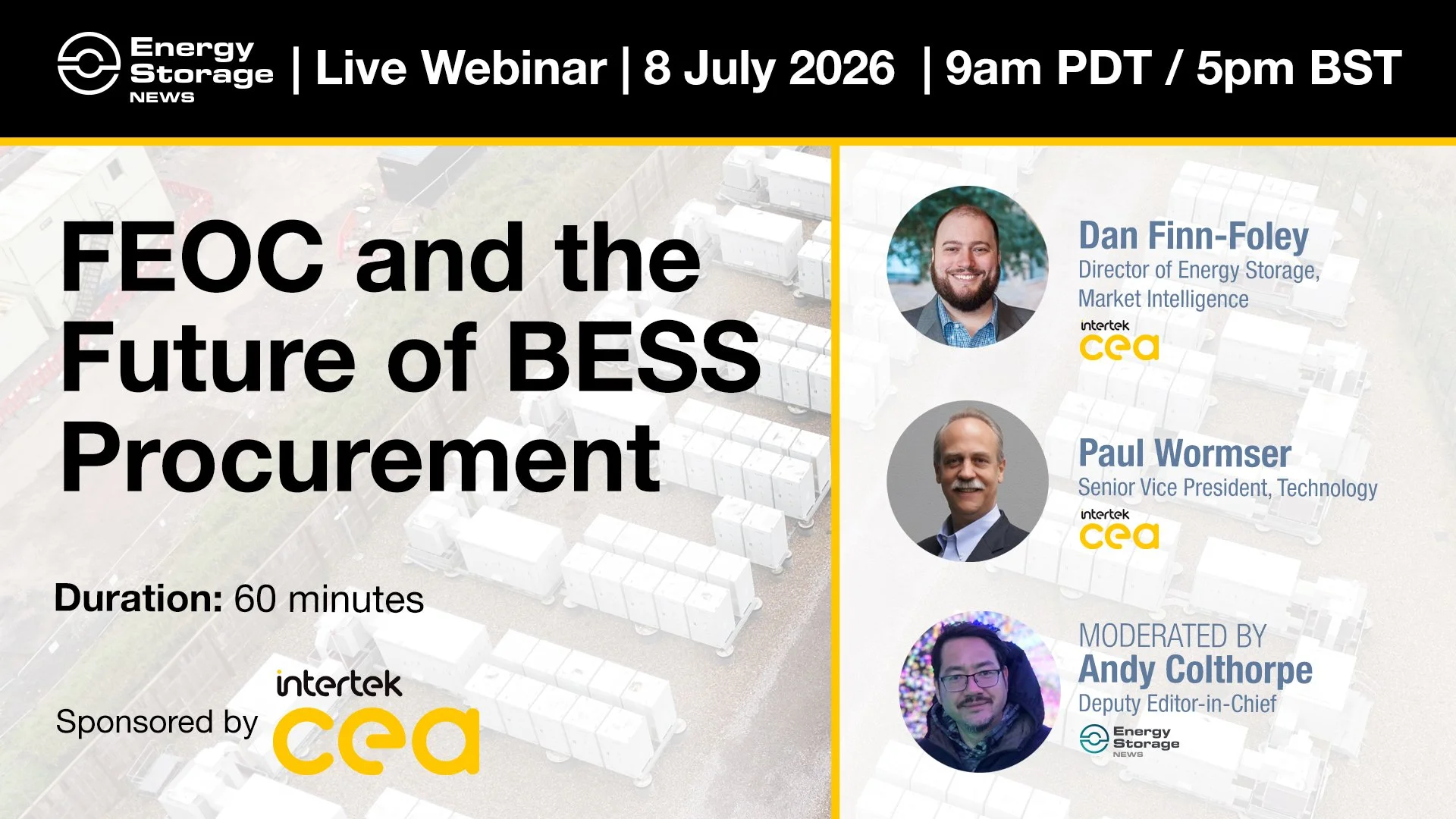
In this Energy Storage News webinar, Intertek CEA experts Paul Wormser and Dan Finn-Foley examine how FEOC requirements are reshaping ESS procurement in the United States.
Foreign Entity of Concern (FEOC) restrictions are reshaping tax credit risk for U.S. solar buyers by targeting both supply chains and company ownership. This report helps buyers interpret the rules as written, assess supplier risk, and document compliance that will stand up to future review.
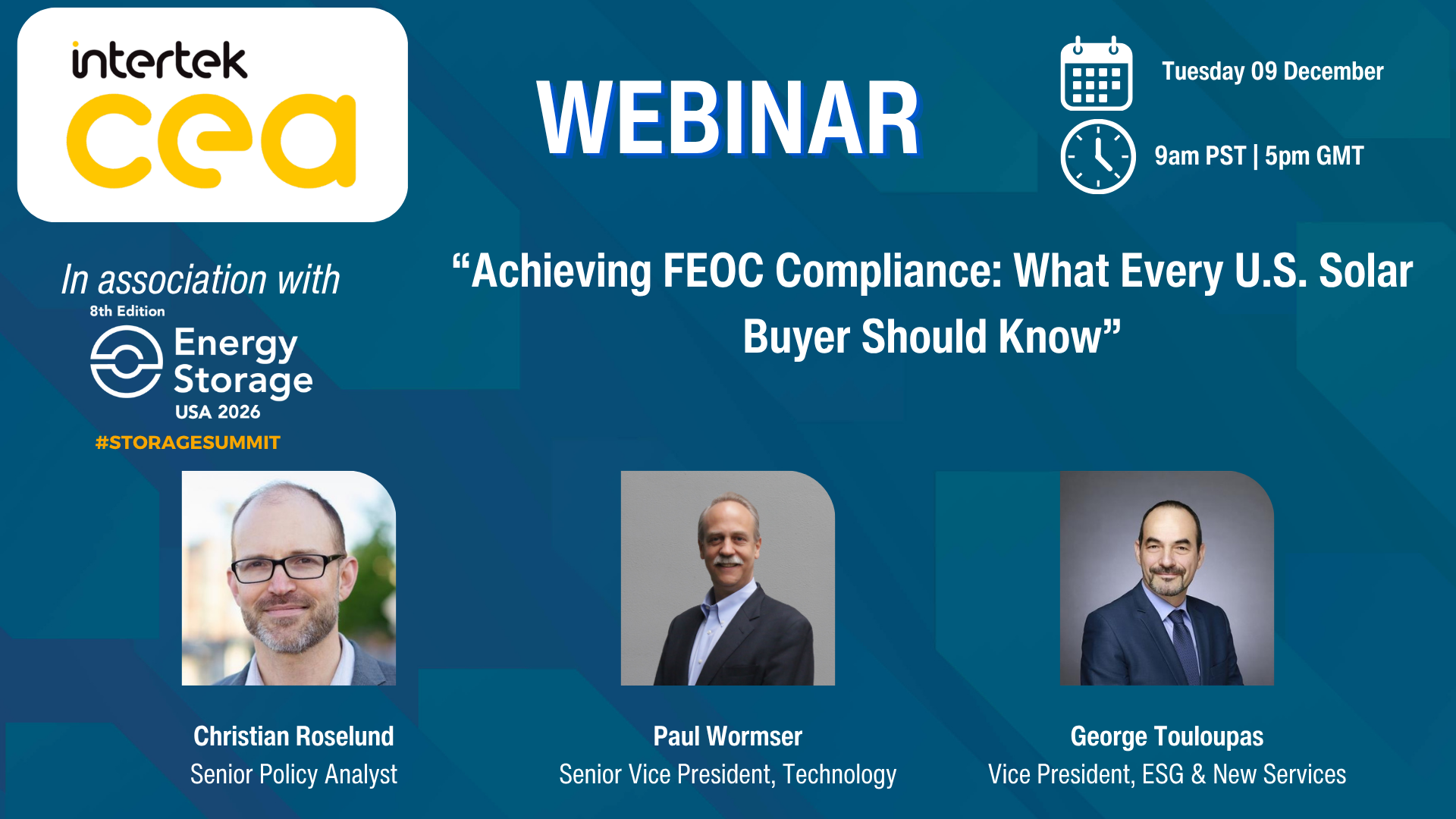
In this webinar, Intertek CEA’s experts break down the top things every buyer should do to prepare for FEOC compliance — with practical guidance you can turn into action.
Christian Roselund, Senior Policy Analyst at Intertek CEA, joins the Clean Power Hour podcast to break down the intricate web of rules, tariffs, and supply chain constraints affecting the clean energy industry.
You can build an entire energy infrastructure project and still wait years to flip the switch. In today’s market, it’s not the modules or permitting that cause the longest delays. Clean Energy Associates’ Eddy Ji explains how high demand for transformers and other essential grid infrastructure equipment is slowing things down.
Weathering the Battery Storm: From Supply Chain Disruptions to New Trade Policies
The Inflation Reduction Act (IRA) and evolving regulations have reshaped U.S. PV module manufacturing, creating challenges for domestic content compliance. This report outlines key strategies to maximize benefits under current U.S. supply chain regulations and incentives.
On Tuesday, October 1, 2024, the U.S. Department of Commerce issued the Preliminary Determination in its countervailing duty (CVD) investigation against PV cells from Cambodia, Malaysia, Thailand, and Vietnam. CEA developed a briefing and analysis of the preliminary determination rates and critical circumstances.
US industrial policy has supported an uptick in annual solar module production capacity, while trade policy has ramped up the cost of cell and module imports. In this pv magazine article, Andy Klump, the founder of CEA, offers some tips to help solar developers plan a route to success.
In this Canary Media webinar, Clean Energy Associates dives into the current state of the lithium-ion supply chain and an outlook for how it will evolve over the next five years.
A new analysis by CEA, commissioned by the American Council on Renewable Energy (ACORE), outlines the potential impacts of the recent U.S. antidumping and countervailing duties (AD/CVD) on solar cells and modules from Southeast Asia.
In this Solar Power World article, Jake Edie, Vice President of Marketing CEA, discusses the changing dynamics in the solar and energy storage markets and emphasizes the importance of maintaining high standards for quality in suppliers, products, project design, and installation to avoid costly issues.
Intertek CEA’s Market Intelligence team has developed a briefing that addresses four recent solar policy developments in the U.S.
In this pv magazine article, CEA’s supply chain and procurement expert Engilla Draper discusses how measures like the Uyghur Forced Labor Prevention Act (UFLPA) have led to significant price disparities in solar panels between the United States and Europe, with U.S. prices being nearly double.
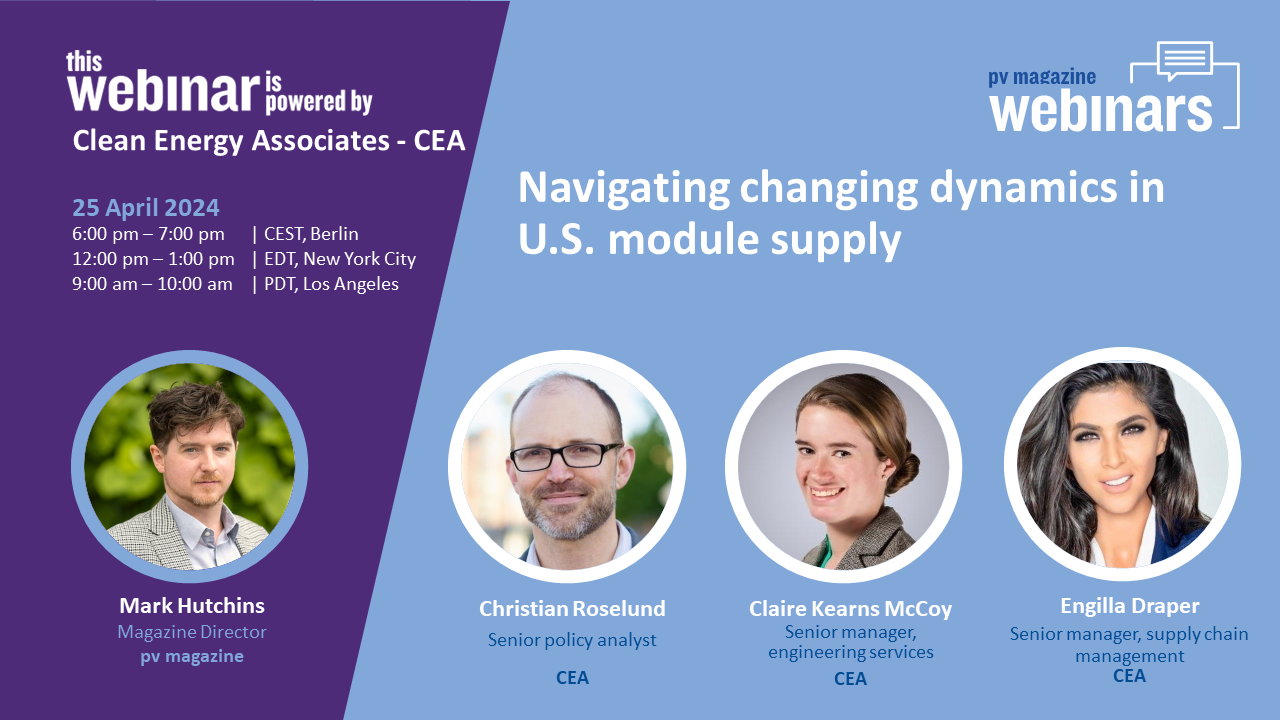
The U.S. solar market is facing a shift from PV module oversupply and falling prices to potential scarcity due to new trade cases. This pv magazine webinar explores the changing supply dynamics, highlighting risks, opportunities, and effective management strategies for buyers and stakeholders.
On April 24, 2024, four U.S. solar manufacturers filed a new anti-dumping/countervailing duty (AD/CVD) petition with the U.S. Department of Commerce (DoC) against imports of solar cells from Cambodia, Malaysia, Thailand, and Vietnam. Intertek CEA has developed an update on this new solar AD/CVD petition.
In this pv magazine webinar, CEA's traceability experts Nicola Licata, Arturo Cortes Chavez, and Joseph Johnson share insights on navigating sourcing strategies and compliance risks in the solar PV module market, focusing on both Chinese and non-Chinese suppliers.
In this Solar Power World article, Jason Knapp, CEA's Director of Government Relations, explains Foreign Trade Zones and how companies can benefit from these special areas in the U.S. by receiving tax advantages to support manufacturing and economic growth, particularly in the clean energy sector.
CEA’s Vice President of Marketing, Jake Edie, recently wrote an article in Renewable Energy World about the most surprising findings in clean energy and what developers and buyers will be watching most closely as 2024 unfolds.
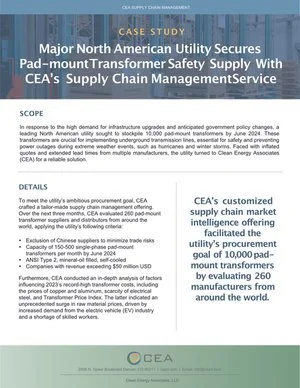
In response to the high demand for infrastructure upgrades and anticipated government policy changes, a leading North American utility sought to stockpile 10,000 pad-mount transformers by June 2024 and turned to Clean Energy Associates (CEA) for a reliable solution.
CEA’s latest report forecasts that the global lithium-ion battery (LIB) cell nameplate capacity will triple by 2025, with North America's capacity growth expected to outpace Europe's, primarily due to the Inflation Reduction Act (IRA).
Going above and beyond can drive up costs when it comes to solar project features such as racking height and module glass strength. But in an ever-warming world, it could take only one extreme weather event to destroy investments. Clean Energy Associates VP - Technology Paul Wormser offers a few tips for developers.
In this episode, Solar Maverick host Benoy Thanjan talks with CEA’s Director of ESG and Traceability, Paul van Brenkelen, about the importance of Environmental, Social and Governance in the solar supply chain.