Services > Field Testing > Lost Bypass Diodes (LBPD) Detection
Lost Bypass Diodes (LBPD) Detection
Have a Question or Need Assistance?
Lost Bypass Diodes (LBPD) in PV Modules
Lost bypass diodes are a hidden defect that can create serious risk in PV systems. Because the issue may not show up in routine inspections, affected modules can remain in service until shading triggers severe local overheating, permanent cell damage, and, in some cases, broader thermal events. Intertek CEA helps owners and operators determine whether LBPD is present, identify affected modules, and support replacement decisions with field evidence.
Why this matters
When cells in a substring with a lost bypass diode are shaded, they lose their protection and are forced to dissipate the power generated by the rest of the string. That power is converted to heat within the affected cells, which can trigger thermal runaway, cause irreversible cell damage, and result in severe localized overheating. Temperatures can exceed 500°C, or about 1,000°F. The risk is that this defect can remain hidden until critical shading occurs, sometimes years after installation.
Why routine inspection may miss it
Typical IR scans do not reliably detect lost bypass diodes under normal inspection conditions because bypass diodes are only activated under shading. In normal, unshaded operation, a lost bypass diode may cause no detectable performance anomaly at all. Flash testing, EL, IR, and visual inspection can all appear normal until shading creates the conditions that expose the defect.
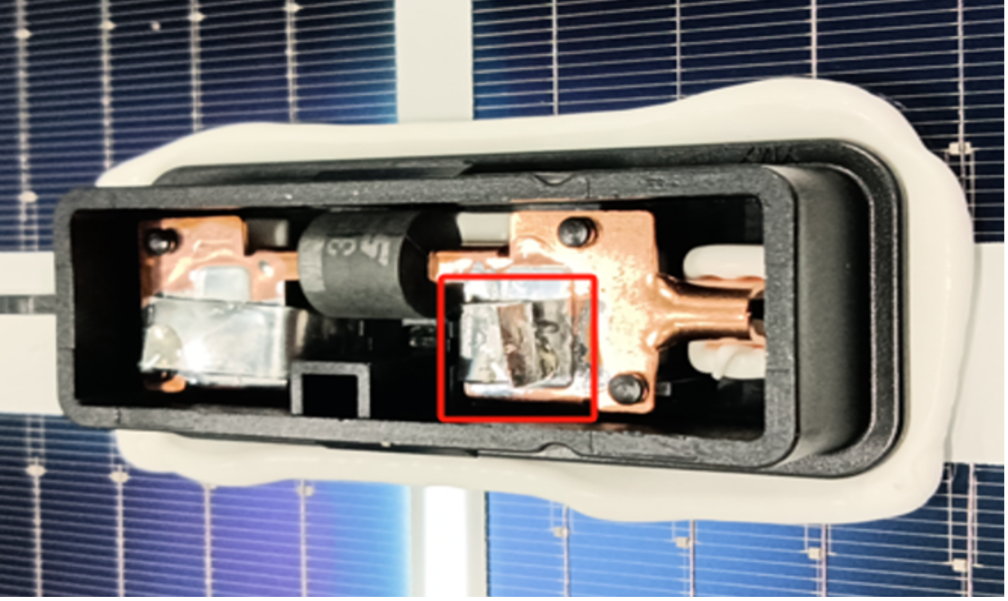
The relevant solder joints are generally checked visually during factory inspection, not verified through electrical or thermal scans. If a solder connection is imperfect, in-line EL inspection and power verification may still show no issue. That means a project can carry this risk without a clear signal from standard checks.
It is possible in principle to provoke shading manually and look for a response with thermal imaging, but that approach is slow, weather-dependent, labor-intensive, and not practical at plant scale. When LBPD is suspected, a more targeted field-testing approach is needed.
How Intertek CEA investigates LBPD
Intertek CEA starts with string-level testing to determine whether lost bypass diodes are present and to identify which parts of a project may be affected. This first phase provides a fast, high-level risk screen for large assets within a few days.
If affected strings are found, we then narrow the issue to the module level using additional electrical measurements and targeted IR under night-time energized conditions. The screening step is fast, non-invasive, and suitable for large assets. Testing is performed at night, so daytime production is not disrupted. The result is a practical path from project screening to module identification and replacement planning.
What the results help you do
Confirm whether LBPD is present in a project area
Prioritize strings for further investigation
Identify which modules should be replaced
Reduce the risk of hotspot-related damage and broader thermal events
Make repair decisions based on field evidence rather than assumptions
When LBPD testing makes sense
LBPD testing can add value at several points in the project lifecycle:
Before commissioning or handover to establish whether modules were delivered with the defect and to protect the buyer’s warranty position
On operating plants that were never screened for LBPD and may carry unknown risk
After a hotspot, burn mark, or thermal event to check whether more affected modules are present in the same batch
During technical due diligence, refinancing, or asset transactions where investors or insurers need a documented answer to a safety question that standard inspections cannot resolve
For TOPCon or glass-glass portfolios where the consequences of unprotected shading conditions may be more severe
Technical background
LBPD is typically linked to a manufacturing solder-bond issue inside the junction box and may affect production batches, not just isolated modules. Because the failure mode originates in manufacturing, modules can leave the factory looking normal while still carrying hidden risk.
The issue is particularly important in modern butterfly-design module architectures. In these designs, one disconnected diode can leave a larger number of cells exposed under shading than in older module layouts. The risk can be even more severe in TOPCon-based portfolios, where unprotected shading conditions may lead to higher hotspot temperatures.
Where this fits in advanced field testing
Lost bypass diode detection is one part of a broader advanced field testing strategy. Intertek CEA combines image-based and electrical field methods to investigate issues that standard inspections may miss, helping owners, investors, and operators make better decisions during commissioning, event response, due diligence, and ongoing asset management.
Latest Field Inspection Insights