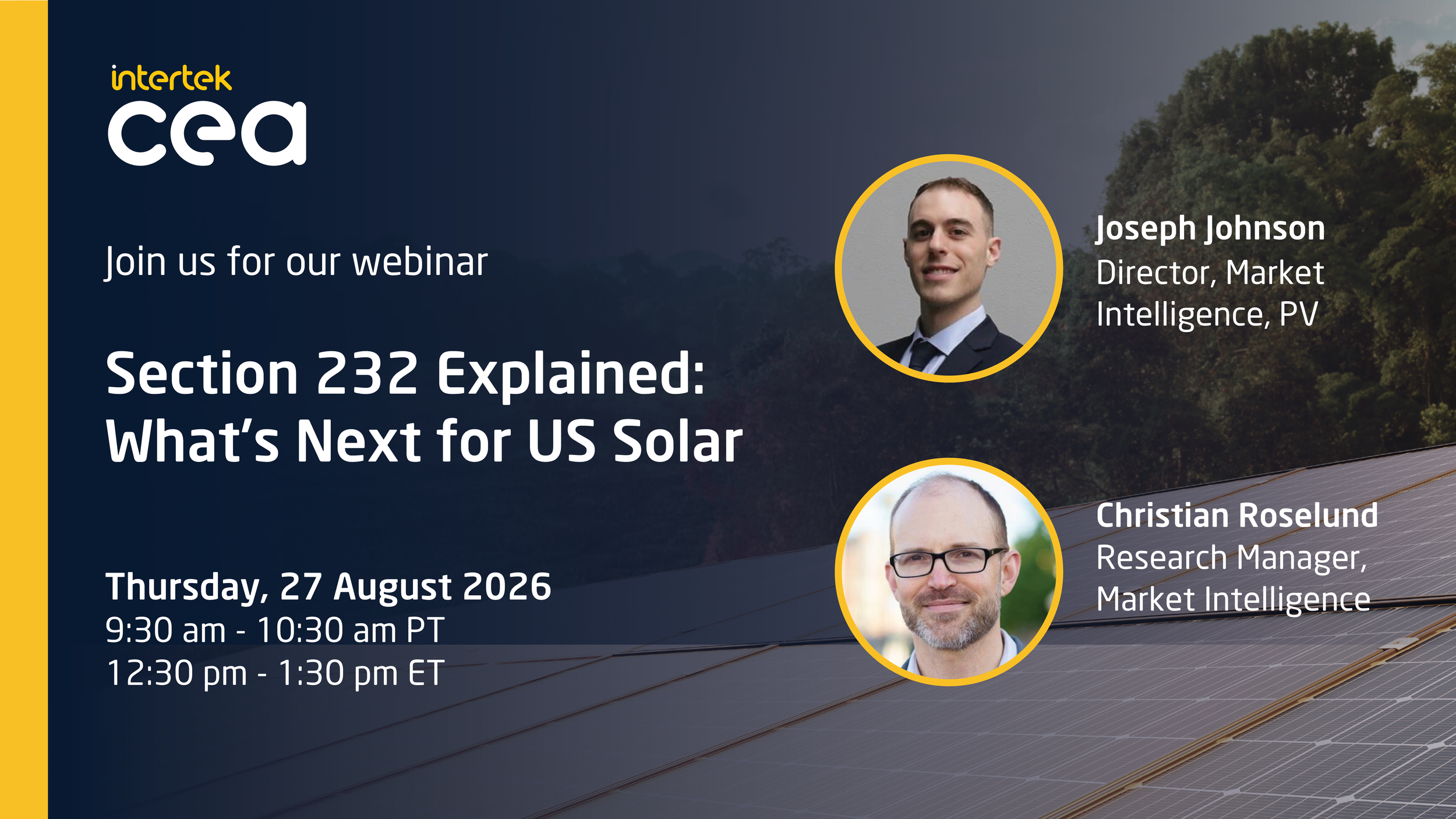
Section 232 Explained: What’s Next for US Solar
In this webinar, Intertek CEA's Joseph C. Johnson and Christian Roselund break down the market impacts of Section 232.
On August 6, the Section 232 investigation into polysilicon and its derivatives resulted in presidential action that set new pricing mechanisms for the United States PV market.
The proclamation imposed new Minimum Import Prices (MIP) on key silicon materials (polysilicon, ingots, wafers, and cells), along with fully assembled modules, with an ad valorem tariff applied on top.
For anyone buying, financing, or building PV projects in the US, these changes create a new price floor and tariff structure that could effect sourcing decisions and project economics.
So how will price adjustments actually take place, and how will Customs and Border Protection (CBP) evaluate equipment and component transactions? How do these new tariffs interact with existing Section 301 tariffs and antidumping and countervailing duties (AD/CVD)? And what can the administration or CBP do to extend or enforce Section 232 through import windows, stockpiling, and enforcement actions?
In this live webinar, Intertek CEA's Joseph C. Johnson and Christian Roselund break down these questions in the proclamation text, along with what it means for the market.
Webinar Content:
Minimum Import Price mechanisms: how price adjustments will take place and how CBP will evaluate equipment and component transactions.
Rules for tariff and duty stacking: interaction of 232 tariffs, 301 tariffs, and AD/CVD.
Considerations on import windows, stockpiling, and enforcement: actions the current administration or Customs and Border Protection can take to extend or enforce Section 232.
Availability of US-produced silicon components: key US import dependencies and state of operational US factories.
Price-setting supply chains: shifts in the primary source of US-destined PV components and composition of US supply chains. • Expected responses from manufacturers: what manufacturing nodes will remain overseas, and what can be on-shored in response to Minimum Import Prices.
Q&A